I moved my dear 89-year-old dad into assisted living last year—sorry I keep going on about it—and I’m watching him grow old with a queasy sense that I’m looking through a telescope at my own future.
Aging isn’t predictable, I know—the telescope isn’t a crystal ball. But enough of it feels like a preview: the body becoming less cooperative (“my legs feel like noodles, Jo,” says my dad), the radius of life shrinking (three meals + TV = that’s all, folks), independence being surrendered one indignity at a time (if you don’t know what a Foley catheter is, go count your blessings).
And I find myself thinking something I don’t remember hearing my parents say when they were my age: I don’t want that part.
Neither, apparently, do many of my friends. Bring up extreme old age at dinner with people in their fifties or sixties and someone will eventually announce the plan: If I can’t recognize anybody, give me the pill. Or: If I can’t wipe my own ass, I’m out. We say it casually enough that you’d think we were discussing when to stop coloring our hair.
Nobody seems particularly horrified. Usually everyone nods, and then we pour more wine.
A super smart friend of mine has built her retirement plan on the assumption she’ll be dead by 80. “But what if you live until 96?” I asked, because that’s the age my financial planner has decided I’m going to die. She made me pinky swear I’d put her out of her anticipated misery when “the time comes” because she knows her kids will be too squeamish to off her.
I don’t remember my parents’ generation talking this way. They worried about dying. We seem increasingly worried about not dying soon enough.
It would be easy to conclude that we’ve become less resilient, more entitled, maybe so accustomed to optimizing our lives that we’re offended by the prospect of a final chapter that earns only two stars. Bad knees? Unacceptable. Memory loss? Hard pass. Pureed food? Please terminate my subscription.
But maybe something more complicated is happening.
For decades, Americans have become increasingly accepting of assisted dying. In 2006, Pew found the country essentially divided over laws allowing physicians to help terminally ill patients end their lives. More recent polling from 2026 shows a majority of people are not morally opposed to the “early exit” under certain circumstances. And while the generational divide isn’t remotely clear-cut, research has often found younger people more accepting of physician-assisted death.
Maybe what has changed isn’t our appetite for life; maybe it’s our relationship with control.
My parents came from a culture in which old age was more readily accepted as something that happened to you. You endured old age, just as you endured your job (“find your passion” wasn’t a thing in those days; “find your pension” was). You “grew old gracefully.” Doctors decided things. God, if you believed in one, eventually made the final call.
My generation has spent adulthood being told something different: design your life! Choose your career! Curate your environment! Optimize your health! Set boundaries! Define your values! Protect your agency! Battle back the lines with Botox!
Why would we suddenly become passive about the biggest decision of all?
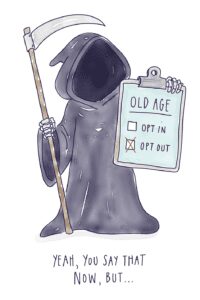 In contemporary debates for assisted dying, relief from suffering and preservation of dignity are central themes, but you know what else is? Autonomy. That sounds familiar to me. When my friends talk about wanting an exit hatch, it’s not about, “I don’t want to live.” It’s about, “I don’t want to live like that.” Such an important distinction.
We fear becoming an obligation on somebody else’s calendar; I don’t even have kids and I’m worried about bothering a caregiver I’ll technically be paying to bother. We fear being trapped inside a body that has betrayed us. We fear dementia. We fear institutional hallways and adult diapers (sorry—briefs). Maybe most of all, we fear losing the authority to say, This is still me, and this is still my life!
Here’s the most certainty-unsettling thing. I’m making predictions about an old woman I’ve never met: me.
Psychologists and health researchers have documented a phenomenon called “response shift.” When people develop serious illnesses or disabilities, they sometimes recalibrate what matters to them and what constitutes an acceptable quality of life. People adapt, and values can change. A condition that healthy people imagine would make life unbearable doesn’t necessarily feel unbearable to the person actually living it.
Which means 50-year-old me might be a lousy spokesperson for 89-year-old me. I’m deciding now what future me would consider a “no, thank you” life—but research suggests future me may move the goalposts.
Today I might insist that needing someone to push me around in a wheelchair and feed me would make life not worth living. At 89, I might adore that wheelchair because it gets me to the dining room where a lovely woman named Sharon is waiting with coffee and “those round things” (what my dad calls pancakes these days).
I might currently regard dependence as indignity. Future me might experience receiving care as intimacy.
Today I find meaning and vitality in exploring different cities. Octogenarian me might revel in the comfort of a warm blanket and the luxury of not having to go anywhere at all.
This is where my neat little exit strategy gets messy. I still believe there are circumstances in which I would want the ability to say enough. I don’t find that belief morbid. If anything, it feels like an extension of a lifetime spent caring about how I live.
But watching my father decline has made me wonder what the real question is that I’m asking myself. It seems to be less, When would I want to die? and more, How much of life am I prematurely declaring unlivable?
Maybe my generation’s willingness to talk about choosing death represents progress: less taboo, more autonomy, more honest conversations about suffering.
Or maybe it exposes a blind spot. We’ve become extraordinarily good at imagining ourselves in control and remarkably bad at imagining ourselves diminished.
Maybe the final challenge of aging isn’t knowing when to let go. It’s leaving enough humility to admit that the person deciding what makes life worth living may change before the answer does.
And in the meantime… I’ll be enjoying a cozy night in under a warm blanket. I might be more ready for ultra aging than I think.

P.S.: Hot tip! Read my book, You Only Die Once: How to Make It to the End with No Regrets before it’s too late.
P.P.S.: Let’s connect on Instagram?
P.P.P.S.: Oh and just in case you missed it… I’d love you forever if you took 16 minutes out of your life to watch my TEDx talk!