Do you have a stuffed animal at home? One that belongs to you and not someone who’s teething?
If the answer is yes, we have so much in common! You, me, and most American adults.
If you answered no, well, Mr./ Mrs. Too Grown Up for Toys, read the rest of the article and I dare you to tell me you’re not sold on this evidence-based coping strategy.
A 2017 survey commissioned by the Build-a-Bear Workshop people reported that 56% of American adults still have their favorite stuffed animal from childhood, and 72% of respondents said they plan to keep their stuffed animal forever.
(Aside #1: research sponsored by a company that implores you to build teddy bears in malls might be a bit biased?)
(Aside #2: if 56% of people still have their childhood stuffed animal as an adult, and 72% say they’ll keep it forever, what’s with the people who plan to turf Buster the Bunny after all these years? Let’s put these people on a watch list.)
Worried that keeping/ adopting plush toys says something unflattering about you?
A study from 2025 showed the most common words adults use to describe stuffed animals include comforting, love, safety, sleep, memories, and happiness. Please note the absence of the words total weirdo and serial killer.
Adults keeping (or buying) stuffed animals isn’t a sign of regression; it’s a healthy indulgence in the bittersweet emotion of nostalgia—what psychologists refer to as the warm ache of revisiting the past. When nostalgia shows up, it tends to bring a cast of supporting characters with it: people we’ve loved, places we’ve belonged, versions of ourselves that felt more hopeful, brave, or uncomplicated. Those things matter, because research consistently finds nostalgia can boost social connectedness and meaning in life.
Now let’s add a stuffed animal to the mix.
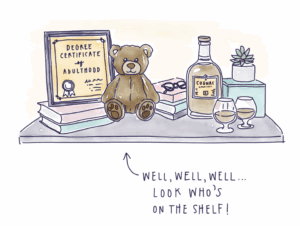 A well-loved bear/ penguin/ lopsided bunny/ one-eyed cat/ whatever summons your snuggle is nostalgia swaddled in fur. It acts as a tactile cue that can pull us back into a felt sense of safety… a bedroom nightlight, a parent’s voice in the hallway, a time when “tomorrow” was mostly exciting.
Long before nostalgia got its modern research glow-up, psychoanalysts waxed on about “transitional objects”—those first “not-me” possessions (often soft objects like stuffed animals) that help children regulate emotions and deal with separation. Kids aren’t the only ones who benefit from anchoring objects that signal steadiness when life gets wobbly.
And oh, how life gets wobbly! Which is where nostalgia becomes less like a charming scrapbook and more like a useful psychological tool. Studies show nostalgia can restore a sense of social support, especially when loneliness is activated. When our brains whisper, “You’re all alone, loser,” nostalgia answers, “Actually, you’re connected.” A stuffed animal can be the physical doorway into that feeling.
Okay so I have buried the lede: researchers have come to the conclusion that teddy bears, in particular, “provide comfort at all stages of life” (👈 you can bet the execs over at Build-a-Bear blew their wads when this study was published).
Psychologists who’ve explored what makes stuffed animals so comforting have this to say: “Teddy bears play an important role in managing emotions, by establishing a particular communication relationship that aims to distract and reassure when struggling with difficult emotions. In other words, when we feel vulnerable, anxious or insecure, teddy bears act as an attachment figure to restore our sense of attachment security.”
This also explains why some adults buy new stuffed animals or collect vintage toys. It’s not (necessarily) that we’re trying to rewind our lives. It’s that we’re intentionally reintroducing softness… a benign, nonverbal kind of care… into world that tends to demand competence and composure when it’s hard to be competent and composed amidst so very many dumpster fires.
Study findings suggest that “touching a teddy bear mitigates the negative effects of social exclusion to increase prosocial behavior.” (This nods to what’s called the embodied theory of emotion, which describes how “our bodies help to constitute the mind in shaping an emotional response.”) Touching a bear—a soft brown bear in particular (because get a load of this: in studies, “softness appeared as the most important variable in the perception of comfort” and “adults showed a preference for more classic teddy bears, with brown tones”)—helps create positive emotional responses.
But wait! There’s more! More teddy bears being studied in the lab! Researchers have found that “the simple act of looking at a teddy bear can reduce the negative emotions linked to social exclusion or to existential concerns.” Said like the stuffed-animal-loving simpleton I am, we can just look at pictures of stuffed animals online and feel better about being left out &/or being dead someday.
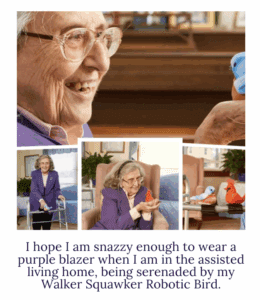
Are you familiar with the world of “animated pets” designed for dementia patients? Alzheimer’s doll and pet therapy is apparently a known resource in helping those with dementia. The MetaDog (name needs work, guys), for starters, “pants, barks, and howls while it moves its head, looks up and side-to-side, blinks and dilates its eyes, plus it gently wags its tail.” Panting and howling at the assisted living center; sounds pretty randy! Not if, but when I develop dementia, I would like a Walker Squawker Robotic Bird that attaches to my walker and soothes me as I wait for no one to visit me.
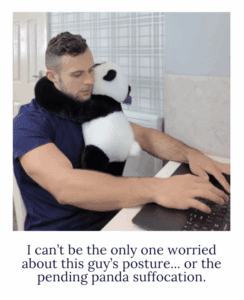
On a similar vein, they sell weighted animals for adults who need help focusing &/or tranquilizing their feelings. Pookie the Panda’s “weighted hug gives you instant comfort after a long overwhelming day.” Or maybe Hallie the Highland Cow is more your speed? The website says “Hallie uses Deep Pressure Therapy (DPT) a calming technique that applies gentle pressure to the body, similar to the feeling of a hug. This pressure activates your parasympathetic nervous system, which is responsible for helping you relax, recharge, and feel safe. When you hug Hallie or let her weighted arms wrap around you, it sends a signal to your brain that says: ‘You’re safe. You can slow down now.’”
Okay, sure, whatever!
 So what?
I am writing this article because I wanted to justify my enduring love for stuffed animals.
Here is a picture of Floppy:
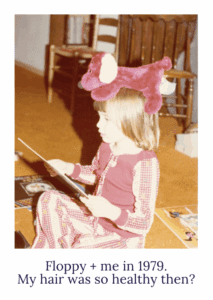
I still have Floppy, several hundred years later, because although I am a generally unsentimental minimalist, I will never get rid of him. What kind of savage puts a puppy down?
I was looking for a present to give myself on the day my book came out. I bought this stuffed Octopus at a fancy kid’s store in Beverly Hills, where they asked if I wanted it gift wrapped. There was no hesitation: “HELL YES!” I blurted, all uncouth-ey (OMG it was probably exactly like that Rodeo Drive scene in Pretty Woman where Julia Roberts was totally out of place. Except I was dressed way less like a prostitute). I unwrapped the stuffed animal on publication day as my present-to-self. This is a picture of me holding the unopened octopus:

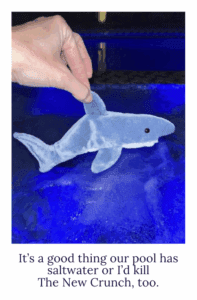
The Husband and I got Crunch, a Beanie Baby shark, on our one-year dating anniversary back in the late 1900s. (We went to Niagara Falls for this hot date, including their casino; please don’t make too much fun.) (Nah, make all the fun you want. It’s warranted.) For the last almost-three decades I’ve traveled with Crunch as a way of feeling close to home when I’m on the road… and then this asshole went and lost him last month. I don’t cry a lot (mostly because I’m emotionally blocked) but I shed several tears over Crunch’s MIA status. (I’m choosing to believe he’s missing and not splayed out on a sushi platter somewhere.) Happy ending though! The Husband promptly bought another one online and while we agreed I cannot be trusted to travel with The New Crunch (because I will invariably desert him at a Residence Inn), we are happy to have our family back in tact. (RIP, The Old Crunch. We logged some air miles, didn’t we?)
So if you still have your stuffed childhood bear/ platypus/ kitten: congratulations… you’ve kept a tiny, fuzzy mental-health artifact. If you’ve acquired a new one: congratulations, you’ve decided your adult life deserves comfort, too. If you left your stuffed animals behind when you got yourself all growed up, well, we’re going to look into that.
Life is short, and while it’s a miracle of amazingness, it’s also hard. In the spirit of whatever gets you through the night, let’s do the things that bring us comfort (ideally not of the intravenous sort). Let’s listen to inexplicably pacifying melancholic music. Let’s revel in the mundane pleasures of life. And let’s go hug a teddy bear… preferably a soft brown one, according to science. (Some of us will be caressing sharks under house arrest.)

P.S.: I don’t have any stuffed animals in my book, You Only Die Once: How to Make It to the End with No Regrets, but I think you’ll be able to pull through okay anyways.
P.P.S.: Let’s connect on Instagram!
P.P.P.S.: Oh and just in case you missed it… I’d love you forever if you took 16 minutes out of your life to watch my TEDx talk!