I am married to a minimalist so every time we are traveling and I want to pop into a cute little antiques store with knick-knacks in the window, The Husband makes a face that can be best described as this: 😑 and then of course because he’s not a tyrant, he obligingly lets me go into the store, where he follows closely behind me to make sure I don’t actually buy anything. “Trinkets and trash” is what he calls anything and everything related to a tchotchke.

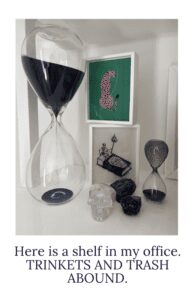
Needless to say, I’m not on the market to bring trash home from vacations. But over the years a few things have made the cut with The Minimalist, and oh, how much joy they bring when I come across them in our home.
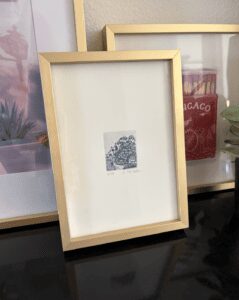
A minuscule painting from a guy in the street in Positano in 1999:
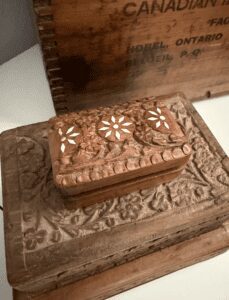
A cute little engraved wooden box from a random shop in Rhodes near the beach in 2006:
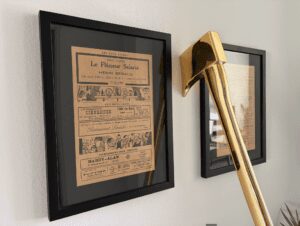
Ads from the back of an old magazine in an impossibly charming old bookstore in Paris in 2009:
Because I realize I’m at risk for sounding like a giant douchebag, bragging about having been to these cool places, I must point out that these purchases were under €10 each. So that’s slightly less douchebaggy.
We’ve been taught a fairly persuasive rule about happiness and spending: buy experiences, not things.
Spend your money on the trip to Prague, not another handbag. Go to the concert. Take the cooking class. Book the ridiculous treehouse in Costa Rica. Research continues to reinforce that experiential purchases tend to produce more enduring happiness than material ones, partly because experiences become intertwined with our identities, strengthen relationships, and are less vulnerable to comparison with what everyone else owns.
But maybe we’ve been a little unfair to stuff… especially stuff with glittery PARIS stamped all over it.
Emerging research suggests that souvenirs can do something psychologically useful: they can keep an experience alive after it has ended.
In a recent study, researchers examined whether souvenirs could sustain travelers’ well-being after they returned home. Across three studies, they found that souvenirs strongly associated with the locality of a destination—its place, people, and past—helped carry elements of the travel experience into everyday life.
 The benefit wasn’t just about owning a nice object, though. Souvenirs appeared to support well-being partly through their sentimental value and their ability to reconnect people with meaningful aspects of the trip. The trinket worked because of what it represented, not because anyone desperately needed another miniature lighthouse.
This brings us, inevitably, to fridge magnets.
A 2024 study examined what happens to souvenir magnets after vacations. Researchers interviewed magnet owners (can we just pause for a moment to acknowledge how funny that sounds? “Researchers interviewed magnet owners”?) about their everyday interactions with these exceptionally unglamorous objects.
It turns out the lowly fridge magnet punches considerably above its psychological weight.
Because magnets are so visible in the home, participants encountered them repeatedly during ordinary routines. Those encounters prompted what the researchers called “post-holiday memory work”: recalling places, people, events, and emotions from trips. These recollections were usually accompanied by positive emotional responses. The magnet didn’t just say, “Oh yeah, I went to Barcelona”; it said, “I remember that hot afternoon in Barcelona when we drank three pitchers of sangria.” (Okay maybe you wouldn’t remember anything after three pitchers of sangria.)
That may be the real value of a souvenir… as a memory jogger. Experiences that once felt sparkly and vivid gradually recede as grocery lists, deadlines, laundry, and the ho-hum moments of life snag our attention. A physical object can interrupt ordinary life and retrieve a piece of a life we might otherwise stop accessing.
So now what?
 This doesn’t mean the path to flourishing involves buying snow globes at every airport you fly through.
The research suggests that the most psychologically valuable souvenirs may be those with real sentimental meaning: something connected to a specific place, person, experience, or a meaningful story.
A handmade bowl bought from the woman who taught you to cook in Oaxaca probably has more memory-retrieval power than a generic sweatshirt bought in a panickey sprint through the terminal.
Visibility may matter, too. A souvenir buried in the back of a closet is so obviously out of sight, out of mind. Something incorporated into everyday life—a framed photograph, piece of art, ornament, magnet, mug, or strange ceramic donkey strategically positioned beside the coffeemaker—gets repeated chances to remind you that your life extends beyond whatever small stuff you might be sweating.
So for sure, still prioritize experiences over accumulating possessions. But while you’re having the experience, buy the souvenir. Not because you need another thing, but because someday, standing half-awake in your kitchen on an otherwise forgettable Tuesday morning, that goofy little donkey may transport you somewhere wonderful.

P.S.: I know my book, You Only Die Once: How to Make It to the End with No Regrets isn’t a souvenir but still. It’s worth it.
P.P.S.: Let’s connect on Instagram!
P.P.P.S.: Oh and just in case you missed it… I’d love you forever if you took 16 minutes out of your life to watch my TEDx talk!